
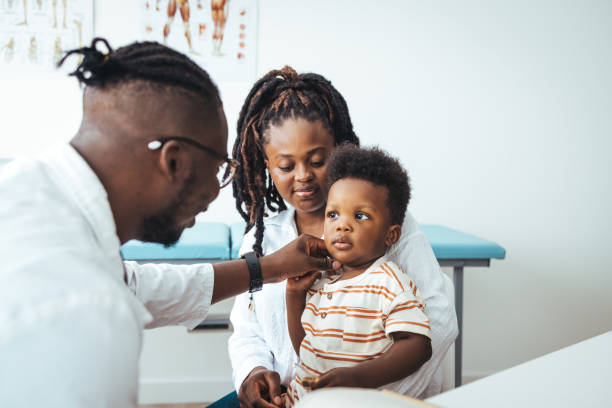
Nigeria has no shortage of clinics. Every estate has one. Every street corner has a chemist who will see your child, give a diagnosis, and send you home with something. So why would you go anywhere else? Here are five signs that the answer matters more than you think.
Let me be honest about something first.
General clinics are not bad. A good general doctor is a genuinely useful thing. For a straightforward adult illness, a routine prescription refill, a quick look at a wound. They do exactly what they are supposed to do.
But children are not small adults. Their bodies work differently. Their immune systems are still developing. Their symptoms present differently at 3 months than at 3 years than at 10 years. Conditions that are mild in an adult can move very fast in a child. And certain things like developmental delays, chronic conditions, newborn concerns — require a kind of specialised, longitudinal knowledge that a general clinic is simply not set up to provide.
The truth is this: in Nigeria, most children who need a paediatrician are instead seeing a general doctor or a chemist. Not because their parents don’t care. Because no one has told them what the difference looks like in practice.
This article is that conversation.
| A child is not a small adult. The medicine is different, the dosing is different, the way symptoms present is different, and the stakes of missing something are different. Specialist training in paediatrics exists for exactly this reason. |
The 5 Signs
| 01 | Your child keeps going back with the same problem Recurring illness that never fully resolves You have been to the clinic three times in two months for the same cough. Or the same ear infection. Or the same fever with no clear cause. Each time, you are given a prescription. Each time, your child improves briefly — and then it comes back.This is not bad luck. This is a pattern. And patterns in children’s health mean something.Recurring chest infections can be the earliest sign of undiagnosed asthma — one of the most common and most undertreated conditions in Nigerian children. Recurring ear infections can cause progressive hearing loss that affects speech and school performance in ways that only become visible years later. Recurring fevers without a clear source can indicate an underlying immune issue, a chronic infection, or a missed diagnosis. A general clinic treats the episode. A paediatrician investigates the pattern. What to do: If your child has had the same type of illness more than twice in three months, they need a specialist assessment, not another course of the same antibiotic. |
| 02 | Something about your child’s development feels off Speech, movement, behaviour, or milestones that don’t seem right You notice that your child is not talking as much as other children the same age. Or they are still not walking steadily at 18 months. Or their attention seems very different from their siblings at the same stage. Or they have been unusually quiet recently — withdrawn in a way you can’t explain.You mention it at the general clinic. The doctor says they will grow out of it. Or they say every child develops differently. Or they don’t really engage with the question at all.This is one of the most common and most costly ways that developmental delays are missed in Nigeria. Not because the concern wasn’t real. Because the doctor seeing the child was not trained to assess it.Developmental screening — checking speech, motor skills, social development, and cognition against age-appropriate milestones — is a core part of paediatric training. It is not something a general doctor does routinely. It is not something a chemist can assess at all. And the window in which early intervention is most effective is narrow. A speech delay caught at 18 months responds very differently to support than one caught at age 4. What to do: If something about your child’s development has been worrying you — even quietly, even if you can’t quite name it — that feeling deserves a specialist assessment. Not dismissal. |
| 03 | Your child has a diagnosis that needs long-term management Sickle cell disease, asthma, allergies, recurrent infections, or any chronic condition Some diagnoses are not one-off events. They are conditions that will shape your child’s health across their entire childhood — and possibly into adulthood. These conditions require a kind of care that goes far beyond a prescription at each visit.Sickle cell disease needs structured clinic visits, medication review as your child grows, crisis prevention planning, and a family that understands the condition deeply enough to act fast when something changes. Asthma needs trigger identification, inhaler technique review, an action plan for flare-ups, and monitoring of how the condition changes with age. Severe allergies need testing, an emergency plan, and school communication protocols.A general clinic can manage a stable acute episode. What it cannot provide is the longitudinal, structured, protocol-driven care that these conditions require to keep a child out of hospital and developing normally.At Hope Children’s, chronic condition management is not an add-on. It is built into the consultation model — scheduled visits, written plans, family education, and a doctor who knows your child’s baseline so well that a change is obvious. What to do: If your child has been diagnosed with any chronic condition and is not currently under the care of a specialist paediatrician, that needs to change. The difference in outcomes, over a childhood, is significant. |
| 04 | Your child is under two (especially a newborn) The first two years are the highest-risk and highest-stakes window of childhood The first two years of a child’s life are medically unlike any other period. The immune system is immature. The physiology is different. Symptoms that are mild in an older child can be life-threatening in a three-month-old. Fever in a newborn is not the same as fever in a five-year-old. Feeding problems, weight gain, jaundice, breathing changes — all of these need eyes that are trained to see what they mean at this specific age. And yet, in Nigeria, newborns and infants are routinely seen at general clinics — or not seen at all between the discharge from the maternity centre and the first clear illness. The well-child visits that should be happening at 2 weeks, 2 months, 4 months, 6 months — catching the concerns that develop quietly before they become obvious — are simply not happening.This is not a criticism of parents. It is a gap in how Nigerian healthcare has been structured. But it is a gap with real consequences — developmental concerns caught late, nutritional deficiencies that affected months of growth, vaccination delays that left children exposed.The first two years are when paediatric specialist care matters most. Not just when something goes wrong. From the beginning. What to do: If your child is under two and has never had a structured well-child visit with a paediatrician, that is the first appointment to book. Not because something is wrong. Because this is when the foundation is built. |
| 05 | You have left the clinic more confused than when you arrived Unclear diagnosis, no explanation, or an answer that doesn’t sit right You sat in that consulting room. The doctor looked at your child for three minutes. They wrote a prescription. You asked what was wrong and the answer was vague — ‘it’s just a viral thing’, ‘give this and monitor’, ‘it will pass’. You left with medication you didn’t fully understand for a diagnosis you weren’t sure about.And then you came home and Googled it.This is not a small thing. Parents who don’t understand what is wrong with their child cannot monitor effectively. They don’t know what improvement looks like, or what a warning sign looks like, or when to come back. They over-worry about some things and under-react to others — because they are working without the information they need.Clarity is not a luxury. It is a clinical outcome. A parent who leaves a consultation understanding exactly what is happening, what to watch for, and who to call if something changes is a parent who can actually manage their child’s health between appointments. At Hope Children’s, no parent leaves without understanding. That is not a brand statement. It is the standard Dr. Toni built the clinic around. What to do: If you have ever left a clinic confused, uncertain, or with a feeling that your questions were not really heard — you deserve a different kind of care. That kind exists. |
General Consultation vs Paediatric Specialist: What’s Actually Different
For parents who want to understand the clinical difference clearly — not as a critique of general medicine, but as a factual picture of what paediatric specialisation adds:
| General Clinic | Paediatric Specialist | |
| Training | General medical training — sees adults and children | 4–6 years specialist training in children’s health only |
| Age-specific knowledge | General awareness of childhood illness | Deep expertise in how diseases present differently at each developmental stage |
| Developmental screening | Rarely included in a standard consultation | Built into every visit — growth, speech, motor, behaviour |
| Chronic condition management | Can manage mild cases; refers complex ones | Structured long-term programmes: SCD, asthma, allergy, recurrent infection |
| Vaccination knowledge | Follows basic schedule | Full EPI schedule plus additional vaccines; knows contraindications and catch-up schedules |
| Newborn and neonatal care | Limited or referred out | Core expertise — from birth, first 1,000 days, and beyond |
| Parent education | Time rarely allows for it | Built into the consultation model — parents leave understanding, not guessing |
| Continuity of care | Whoever is on duty | Same doctor, same record, same relationship across years |
A Word of Fairness: Both Have Their Place
I want to be clear about something, because this article is not an attack on general clinics.
For a straightforward childhood illness — a mild viral fever, a mild cold, a minor skin infection — a good general doctor is entirely appropriate. Not every cough needs a paediatrician. Not every runny nose requires a specialist appointment. Part of what we do at Hope Children’s is help families develop the judgment to know the difference.
What we are saying is this: when the situation is more complex — when it is chronic, recurring, developmental, or when your child is very young — the gap between general care and specialist care becomes significant. And in those situations, your child deserves the specialist.
The best version of Nigerian paediatric healthcare is one where general doctors and paediatricians work together — where a trusted GP refers to a specialist when the situation warrants it, and where that specialist sends a clear report back. That is the referral relationship we are actively building with GPs and OB/GYNs across Abuja. Because the goal is not competition. It is better outcomes for every child.
| Every child deserves a doctor who has spent years learning specifically how children’s bodies work. That is not elitism. It is the standard of care that every family in Abuja should be able to access. |
Questions Parents Ask
Is a paediatrician more expensive than a general clinic?
Often, yes — a specialist consultation is priced accordingly. But this is a question worth thinking about differently. A child who sees a general clinic four times for the same recurring problem that goes undiagnosed costs more — in fees, in missed days, in stress — than one visit to a paediatrician who identifies the underlying issue and creates a plan. The cost of inadequate care is rarely visible in a single appointment. It accumulates across months and years.
My child seems fine most of the time. Do they really need a specialist?
If your child has any of the five signs above — recurring illness, developmental concerns, a chronic diagnosis, is under two, or if you have consistently left consultations without clarity — then yes. ‘Seeming fine most of the time’ is exactly the presentation of conditions that are being undertreated rather than managed. It is the space between crises, not the crises themselves, where good paediatric care does its most important work.
How do I know if Hope Children’s is the right fit for my child?
If you are in Abuja, your child is between birth and 12 years old, and you want a paediatrician who will know your child over time — not just treat each visit in isolation — we are the right fit. Book a first appointment. Come and see us. The consultation will tell you everything you need to know.
Can I bring my child even if they are currently seeing a general doctor?
Absolutely. Many of our families come to us after years with a general clinic — sometimes because of a recurring problem, sometimes because they simply want a paediatrician now. We do not require any referral. Bring whatever records you have. We will build the picture from there.
Your Child Deserves Specialist Care
Hope Children’s & Neonatal Hospital is in Kado, Abuja. We are a dedicated paediatric and neonatal centre — not a general clinic that sees children on the side. We see children from birth through age 10, seven days a week, with unhurried consultations, written care summaries, and a doctor who will know your child by name — and by history.
If you recognised your child in any of the five signs above, this is where to start.
| Book Your Child’s First Appointment → hopehospital.ng/book Or WhatsApp us · Open 7 days a week · Kado, Abuja |
About the Author
| Dr. Anthonia Shagaya (Dr. Toni) MB ChB · General Paediatrics · Subspecialty in Paediatric Infectious Diseases (USA) Dr. Toni is the founder and Medical Director of Hope Children’s & Neonatal Hospital in Kado, Abuja. After training in the United States and returning to practice in Nigeria, she spent years watching families navigate a healthcare system that treated their children’s complex needs as general adult medicine with smaller doses. She built Hope Children’s as the alternative — a dedicated paediatric centre where every child is known, every parent is heard, and the standard of care is the one every family in Abuja deserves. |
Related Reading
- When Should You Take Your Child to See a Paediatrician?
- What Is a Well-Child Visit — And Why Every Nigerian Parent Needs One
- Sickle Cell Disease in Children: What Structured Care Actually Looks Like
Hope Children’s & Neonatal Hospital · hopehospital.ng · Kado, Abuja · Open 7 days a week